
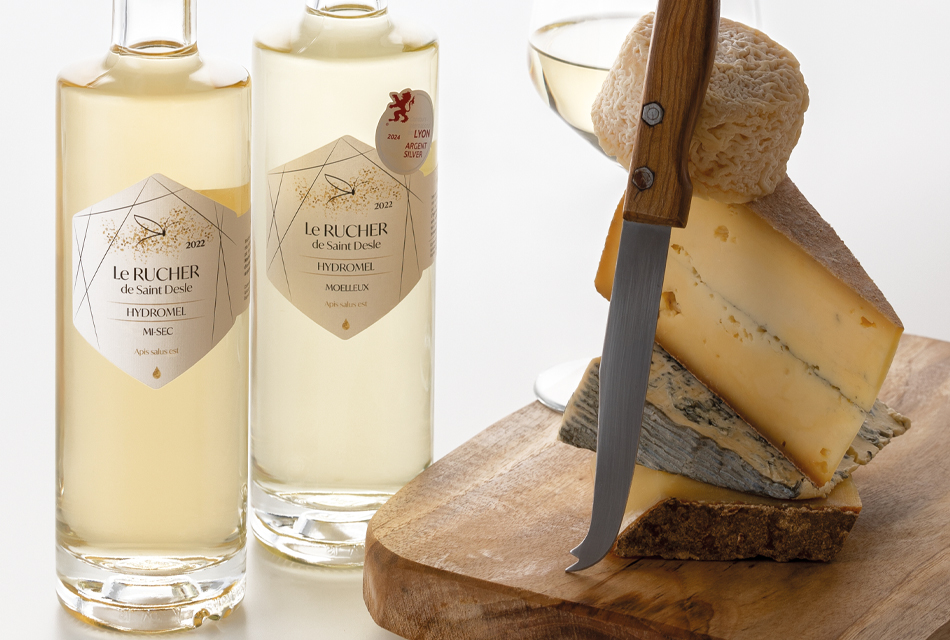
Long dismissed as a medieval curiosity, mead is making a remarkable comeback at the table, championed by a new generation of passionate artisans. At Le Rucher de Saint Desle, near Vesoul, Corinne and Christophe Duchanoy — former agri-food engineers and devoted food lovers — have risen brilliantly to the challenge of restoring this ancestral beverage to its former glory.
Mentioned in Scandinavian mythology as the drink of newlyweds — the origin of the term “honeymoon” — mead is produced by fermenting a mixture of water and honey (from the Greek hydro = water, mel = honey). Depending on the blend and method, it can be dry or sweet, still or sparkling, and offers a wide aromatic palette ranging from white and exotic fruits to honey, flowers, spices and delicate herbal notes. Vinified like an age-worthy wine, it reveals its full complexity after two years of maturation, sometimes longer.
With around one hundred hives, the Duchanoys control the entire process, from the apiary to the bottle. “From March to September, we are in the apiary, harvesting plain honeys (fruit trees, hawthorn, acacia, summer flowers, lime blossom…) and mountain honeys from the Plateau des 1000 Étangs in the Vosges Saônoises. From October to February, we work in the cellar with our fermenters (240 and 625 litres) and new Burgundian barrels. Our honeys are neither heated nor filtered to preserve their natural flavours. The blending choices and long maturation in vats or wood create real vintage diversity”.
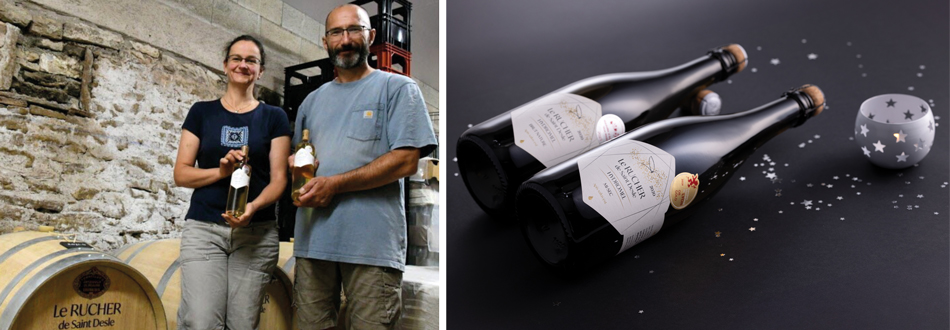
Their range showcases this expertise: four still meads (dry, off-dry, sweet and mountain), two traditional-method sparkling cuvées, two eaux-de-vie produced by distillation, a liqueur and a mead vinegar made using the traditional Orléans method.
It is above all in the gastronomic sphere that their work stands out. “A dry mead pairs beautifully with delicate fish, poultry or creamy mushroom dishes. Off-dry works with both savoury and sweet: cheese, foie gras, spiced cuisine or dark chocolate. Sweet mead complements nut-based desserts or blue cheeses, while the sparkling cuvées shine as an aperitif or with festive desserts. As for the eaux-de-vie, they bring a playful twist to a ‘beekeepers’ interlude’ alongside frozen nougat!”. These pairings reveal the remarkable versatility of this multifaceted drink.
With an annual production of 6,000 litres and regular collaborations with renowned chefs, Le Rucher de Saint Desle plays a key role in re-establishing mead as a full-fledged gastronomic beverage. Honey, water, passion and patience: this is the estate’s motto, serving both flavour and biodiversity.
Color: clear and star-bright, with an intense golden-green color.

At the gateway to the Bessin, between Caen and Bayeux, Domaine de la Flaguerie...
While various grains may contribute to their compositions, the majority of traditional Korean alcohols...