
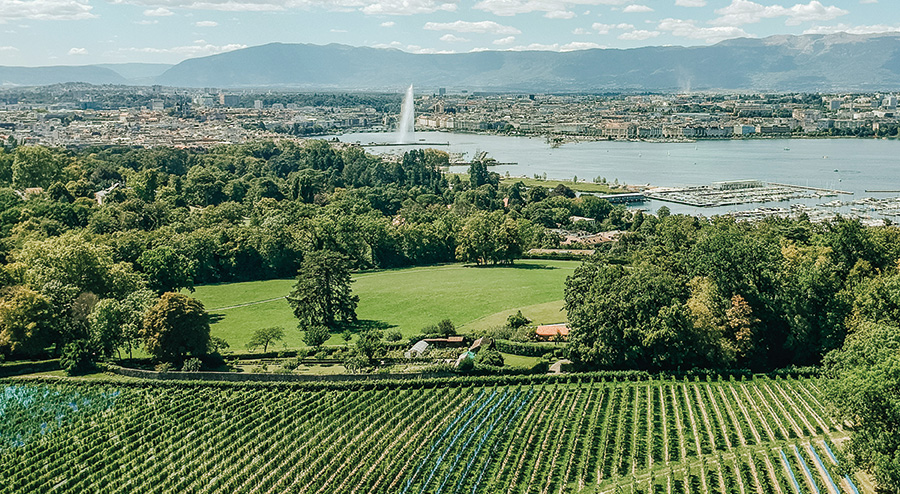
In Geneva, city and countryside intertwine in surprising ways. Barely ten kilometres from the headquarters of the United Nations and the World Trade Organization, picturesque vineyard plots planted with Garanoir, Sauvignon Blanc, Chardonnay and Merlot produce increasingly renowned wines. The proximity of the Jura Mountains and the Pre-Alps, together with the influence of Lake Geneva and the Rhône, creates a mosaic of microclimates. Combined with the remarkable diversity of soils, this variety has encouraged winegrowers to broaden the region’s traditional range of grape varieties, historically based on Gamay and Chasselas. In a wine region that has always been a pioneer, growers continue to experiment with new varieties in order to offer a cosmopolitan clientele a wide range of distinctive, characterful wines.
Although Chasselas remains the dominant white grape variety, Geneva’s winegrowers have achieved considerable success at international wine events with wines made from classic varieties such as Chardonnay. Among the reds, Gamay remains the leading variety, producing excellent, beautifully structured wines. However, Pinot Noir and other red grape varieties are steadily gaining ground.
Key figures
• 9% of Switzerland’s vineyard area
• 47 grape varieties
• 130 producers
• 56% red varieties (763 ha)
• 44% white varieties (592 ha)
Source: www.swisswine.com
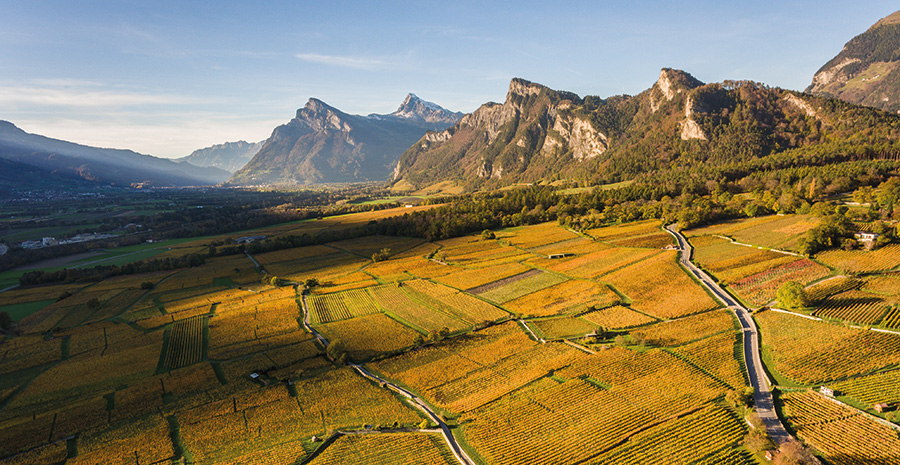
This designation encompasses the sixteen wine-producing cantons of German-speaking Switzerland. Switzerland’s third-largest wine region can be divided into three main areas. The western part includes the vineyards of the cantons of Basel (105 ha) and Aargau (400 ha); the central part comprises Zurich (607 ha), Schaffhausen (490 ha) and Thurgau (270 ha); while the eastern part encompasses Graubünden (410 ha) and St. Gallen (220 ha). One of the defining features shared by the German-speaking cantons is that a quarter of the vineyard area is planted with Pinot Noir, locally known as Blauburgunder, which produces remarkably nuanced red wines. White grape varieties, dominated by Müller-Thurgau, still known in Switzerland as Riesling-Sylvaner, account for 25% of the vineyard area. Specialities of German-speaking Switzerland include Räuschling, Gewürztraminer and Pinot Gris.
The region is experiencing renewed interest in traditional grape varieties that had fallen into obscurity, while also demonstrating a remarkable capacity for innovation.
Key figures
• 18% of Switzerland’s vineyard area
• 50 grape varieties
• 800 producers
•64% red varieties (1694 ha)
• 36% white varieties (962 ha)
Source: www.swisswine.com
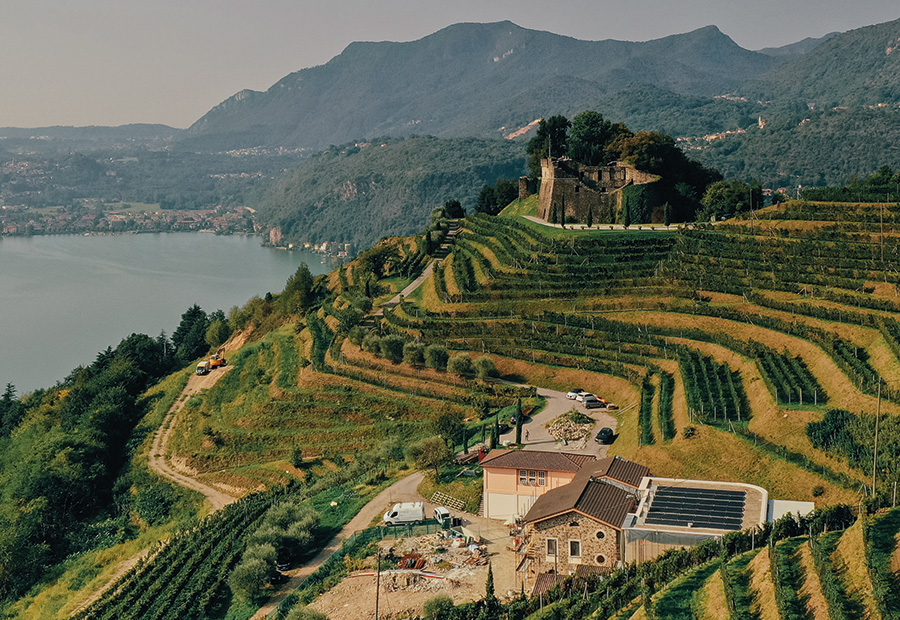
Switzerland’s only wine region on the southern side of the Alps, Ticino combines abundant rainfall with generous sunshine. This climate, shaped by maritime influences, has favoured the development of Merlot. Nearly 80% of Ticino’s vineyards are planted with Merlot, which, when grown on favourable sites and vinified with the utmost care, can prove a genuine rival to the red wines of Bordeaux. It thrives equally well on the steep terraces of the Sopraceneri in the north of the canton and on the gently sloping vineyards of the Sottoceneri. Sometimes vinified as a white wine, Merlot Bianco is an elegant white that is attracting a growing number of enthusiasts.
Originally from Bordeaux, Merlot has found a second home in Ticino, where it produces distinguished wines and gives rise to some of Switzerland’s most prestigious cuvées. Thanks to effective communication centred on a single, universally recognised grape variety, Ticino has developed the strongest and most widely recognised identity of all Switzerland’s wine regions.
Key figures
• 8% of Switzerland’s vineyard area
• 26 grape varieties
• 97 producers
• 89% red varieties (1052 ha)
• 11% white varieties (129 ha)
Source: www.swisswine.com
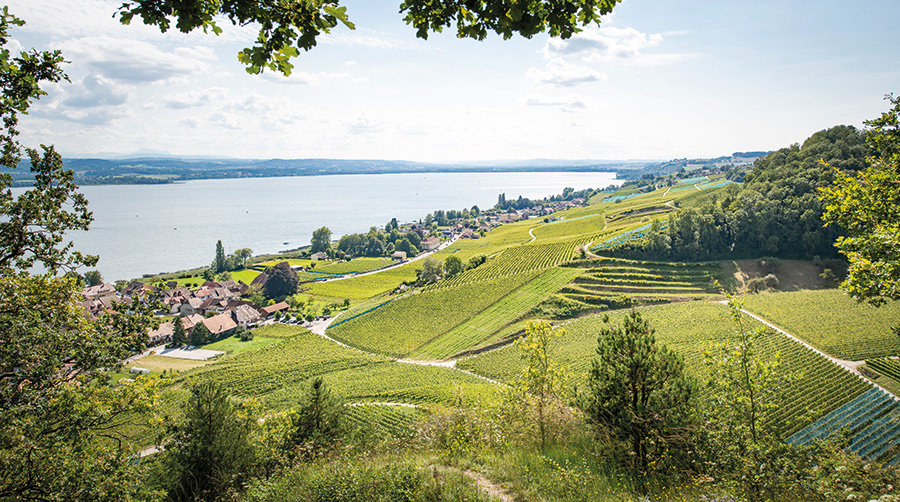
One region, three identities: the vineyards of the Three Lakes flourish on gently sloping hillsides across three distinct areas. The largest (606 hectares) stretches along the western shore of Lake Neuchâtel and forms the wine region of the canton of the same name. Its vineyards are planted mainly with Chasselas and Pinot Noir, which are crafted into a range of distinctive specialities. The second area (222 hectares), located in the canton of Bern, lies alongside Lake Biel. The third (116 hectares) borders Lake Murten and is home to Vully, one of the few Appellations d’Origine Contrôlée to extend across two different cantons, Vaud and Fribourg. It is particularly known for its Freiburger and Traminer, the regional names given to wines made from Freisamer and Gewürztraminer respectively.
The most widely planted red grape variety in Neuchâtel is Pinot Noir, which produces excellent red wines as well as the famous Œil-de-Perdrix, a delicate, fruity rosé created in Neuchâtel. The best-known white wines of Neuchâtel are its lively Chasselas. The region also produces elegant specialities, a selection of sparkling wines and Chardonnays that have received awards on more than one occasion.
Key figures
• 6% of Switzerland’s vineyard area
• 12 grape varieties
• 78 producers
• 57% red varieties (533 ha)
• 43% white varieties (409 ha)
Source: www.swisswine.com
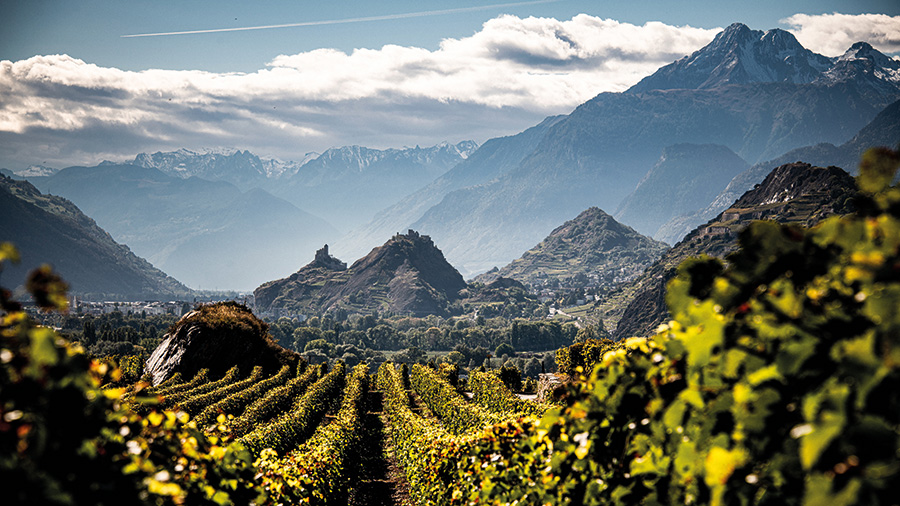
The spectacular, often terraced vineyards of Switzerland’s largest wine region stretch along the upper reaches of the Rhône. In the heart of the Alps, this valley, carved out by retreating glaciers 20,000 years ago, enjoys a particularly dry climate, with just 650 millimetres of rainfall a year, and abundant sunshine, averaging 2,500 hours annually. Enhanced by episodes of the foehn in autumn—a strong, warm wind—this microclimate is particularly conducive to the ripening of late-ripening grape varieties, many of which are native to the region. It also allows vines to be cultivated at much higher altitudes than in other parts of the country, as in Visperterminen, which lies at an altitude of 1,100 metres. Picturesque and captivating, Valais—and the same can be said of its wines—never leaves visitors indifferent.
Among the region’s grape varieties is Petite Arvine, with its aromas of citrus fruit and wisteria, its vibrant acidity and distinctive saline notes on the finish. Among the red varieties, Cornalin stands out for its beautiful expressions, combining velvety texture with generous fruit.
Key figures
• 32% of Switzerland’s vineyard area
• 55 grape varieties
• 390 producers
• 59% red varieties (2722 ha)
• 41% white varieties (1914 ha)
Source: www.swisswine.com
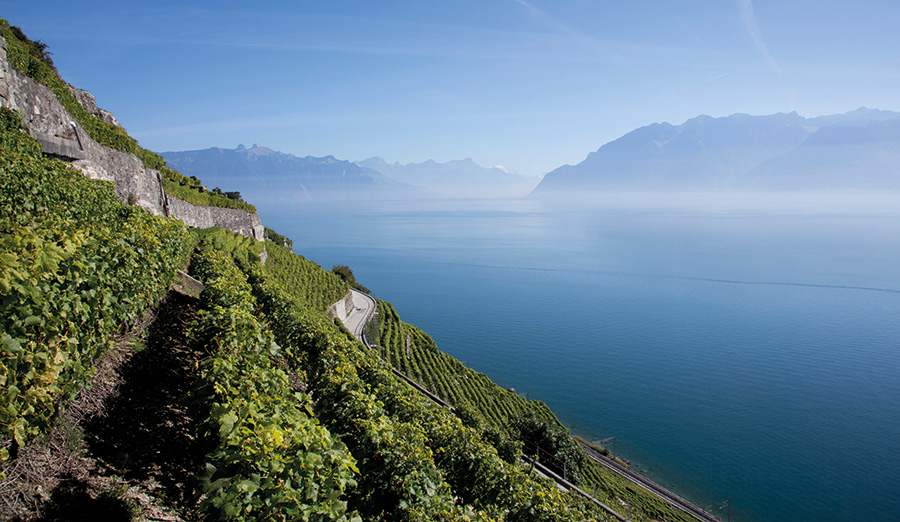
Proud of its appellations, its thousand-year history, centuries-old traditions and spectacular landscapes, the canton of Vaud is divided into six sub-regions and eight AOCs. Covering more than 3,782 hectares, this wine region, strongly influenced by the proximity of its lakes, abounds in oenological, historical and cultural treasures.
As the only Swiss wine region where white grape varieties account for the majority of plantings, Vaud has a particular devotion to its emblematic grape variety. Yet in this region, where the notion of terroir is deeply rooted, people rarely speak simply of Chasselas, but rather of Yvorne, Féchy, Dézaley or one of the nearly 150 officially recognised wine-producing localities.
Vaud is renowned above all for its fresh, fruity white wines made from Chasselas, whose subtle and varied aromas reflect the remarkable diversity of its soils. Red wines, produced primarily from Gamay and Pinot Noir, account for around a quarter of production.
Key figures
• 26% of Switzerland’s vineyard area
• 79 grape varieties
• 449 producers
• 35% red varieties (1310 ha)
• 65% white varieties (2469 ha)
Source: www.swisswine.com